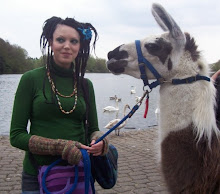
I had been debating having a "green" new year's resolution, but couldn't think of one that I thought was meaningful, or significantly challenging or worthwhile for this year at least.
I decided on something quite separate for an entirely different reason. I made two:
1) look after the house and garden more
2) live more frugally.
It is the second which is or interest to this particular post. So, I have already decided I am to live more frugally. As I say this is not for green purposes, but does come after the consideration and rejection of some similar green style resolutions:
-buy no more new clothes, only second hand
-buy less
-only buy basic clothing etc
I dismissed these for various reasons.
Then today I was reading about the compact whose aim is to buy nothing new. I don't want to permanently go down this route since lots of the new things i buy are fair trade which will directly impact on the lives of others if I stop buying them (don't worry I am not deluding myself by how much it will or won't help - but it certainly won't help people in poor communities if people in rich communities all stop buying their products and instead start living off the waste products of other rich people). Mr Green-Eyed also tells me that we have to consume more in order for the world to carry on turning pretty much. Which I accept, but I actually think that world economics is wrong and we should switch to a non-growth economy. Either way, I don't believe in excess consumption, but I don't think just switching to buying other people's waste is the answer either. The reason there are such good "waste" products in charity shops and on ebay is because people are consuming more new things, so a reduction in consumption in general would be more my speed.
However, I like a challenge, even one riddled with ethical nightmares such as this!
So, my January challenge is to buy nothing new. Nothing new for one month.
Things I am allowed to buy:
-used second hand items
-food and drinks
-food and drinks which come with free gifts so long as the food or drink item would have been bought regardless of the gift.
I will keep you updated :)
Showing posts with label social cost. Show all posts
Showing posts with label social cost. Show all posts
Friday, 1 January 2010

Sunday, 20 December 2009
A petty problem
We are currently a no-pet family, although I am hoping we will be getting cats, rescue cats, 2 of them, after Christmas. That was until my husband read an article in the Guardian saying that some pets are worse for the environment than an SUV. My first instinct was to be outraged. I want a cat, how can a cat be worse for the environment than an SUV? (To be fair, cats aren't it's medium and large dogs which are, according to the article). Then having gotten over my outrage I decided to think rationally - if cats really are that bad for the environment then maybe I shouldn't get two, or even one. It's no good only listening to the green info I want to hear.
I arranged my thoughts into some sort of order and then read the Leo Hickman (who I do really like, I subscribe to his blog, but must have missed this post, I have his books on my amazon wish list too!) article. So, the article is quoting research from Time to Eat the Dog by Robert and Brenda Vale which finds that a cat requires 0.15 global hectares to keep it fed, the equivalent of driving a VW golf for 10000 miles a year, plus the energy required to make the car in the first place. So my two cats is almost at the energy cost of buying a 4.6 litre Toyota Landcruiser and driving it for 10000 miles a year (0.41 global hectares). Luckily I don't drive a Toyota Landcruiser as well then!
My next thoughts all concern the fact that I would be getting a rescue cat, so that cat is already having that footprint regardless of whether I own it or not. So actually so long as I promote responsible pet owning and only get a rescue cat I should probably get the cats so as to reduce the load on the shelters. Plus if it is going to be having the footprint anyway someone might as well get the joy from it, which I would.
My next thoughts all concern all the positives about having a pet. For instance, the joy and love that I myself would get. Then there is the positive personal and social impact that pets have on children (which I don't have yet, but would like to, although of course they have a far larger footprint than a cat, no joke). The article also explained some additional benefits - people with pets have greater immunity and visit the doctor less, 21% less when they are elderly, how many global hectares does that account for one wonders. Plus the mental health benefits that pets bring.
I would also think I might be less likely to go out if I had a pet thereby reducing my consumption and waste in shops, pubs, restaurants and cinemas. Of course I don't drive a car at all, very often. We have a small car between us which neither of us drive very often. I walk to work and get the bus and train further afield, despite the additional time, money and stress costs that this can often entail. I take all my compostable waste to work, I bring home any recyclable waste from work. That's right - I carry bags of waste to and from work despite the fact I walk, often in the rain - because it is the right thing to do. I don't eat any animals (that themselves have an eco footprint), I try to minimise my plastic consumption, I try not to fly. I pay extra to have 100% renewable electricity from Good Energy. We try not to have the heating on, and didn't turn it on at all until December this year (except one freakishly cold day in November).
I don't think that doing that means I can do anything I like, indeed I hate to hear people say, "I can do this ungreen thing because I recycle most of my stuff at home". But actually, surely I have reduced my footprint by that of a cat, so I am still on a positive even if I do have a cat? Plus the fact that my children will be more socially adaptable and I will use the NHS less later in life, and I will go out less. Maybe all these things add up to a cat having less of a footprint than it would seem?
I do think we should consider the ecological footprint of activities we partake in and lifestyle choices we make, but I don't think that means we have to not do anything which carries a number, which everything does. It's a case of weighing up pros and cons, and making thoughtful choices. How many global hectares does going to a pub every friday and saturday take? How many global hectares for out of date food which has been thrown away (I eat yoghurts 2 months out of date), how many global hectares to buy a newspaper every day? How many to have a cup of tea every day?
I appreciate the article for giving me the chance to consider the impact of having a pet (which I already had from a vegetarian standpoint, but i think this post has maybe been going on for long enough!) and I have added the book to my wish list, but I have weighed it all up and will still be getting my cat in the new year :)
(do you know I didn't even discuss the indoor cat/outdoor cat arguments, maybe I will do that when I have the cat)
Saturday, 28 November 2009
ARGH! My hair is not sustainable!!
I have been in a quandary for a while about my hair, which isn't currently, but often is synthetic dreadlocks. At the moment it is woven in human hair dreadlocks. Each has its pros and cons.
The main problem with synthetic dreads lies in the name.... synthetic. As in man made, as in plastic. I avoid plastic where possible, I try to buy natural fibres (although I get guilt over non-organic cotton and the would-be vegan in me has to be squashed every time i buy wool - is there no simple answer?), so why do I have PLASTIC hair?
I feel that my hair is a small drop in the ocean... I maybe use 4 packets of hair per year, each pack is 3oz i think, so not a huge concern. Although it is Chinese produced which throws in more questions and doesn't give any answers, and it comes in packaging, plastic packaging. I do rewear my hair, and i keep it all or sell it, it never goes in landfill.
I do a lot of green things and think that this one little luxury should be OK.
Then I read George Monbiot's blog about how small actions allow people to overlook the bigger ones/. Obviously i am aware of this. When I went on my holiday by international rail last year I was met with criticism from many who fly who told me I did all my recycling and the like. As if my recycling could possibly cancel out hauling a 440 tonne hunk of metal into the sky spilling out jet fuel as it goes. This is what people think though. "Oh I took my own bag to the shop, I can go in my 4x4 and it will all cancel out". They do it with everything, "Oh I walked to work this morning, aren't I healthy, I can have fish and chips for tea and it will all cancel out.... In fact I even took the stairs instead of the lift, I'll have a donut to boot". Um... no.
I don't want to be one of these people though, I try to be more mindful of these things. Now, I don't think my hair could be worse than all the things I do do (except of course if we consider the many pit falls I may accidentally have fallen into), but I also don;t want to be merely neutral. If my hair has cancelled out all the good I do then my foot print is not reduced.
Part of me wants to ignore the issue here and assume my hair has minimal impact (well, I assume it has a big impact else I wouldn't bother, but y'know, minimal environmental impact) but I'm not sure how well the brush-it-under-the-carpet approach suits me. What do you think?
I have not the answers. I like to look good, feeling positive about myself leads me to be more proactive about the other things I care about. It's a complex web. But I am not a fly and don't have to be caught in it. I could find some fo' sure enviornmentally friendly hair. I don't know what that is though... human hair extensions have the potential to have a high social cost (that would be for another blog), natural hair has more washing and styling in it, which uses more water, more product and more electricity. I could go completely au-naturel, but tbh that isn't going to be an option. The web gets stickier and I can see the spider approaching me and I haven't even begun to find the answer.
There is wool, but again the would-be vegan in me debates which is better.
I haven't even talked about dye yet!,
Subscribe to:
Posts (Atom)